
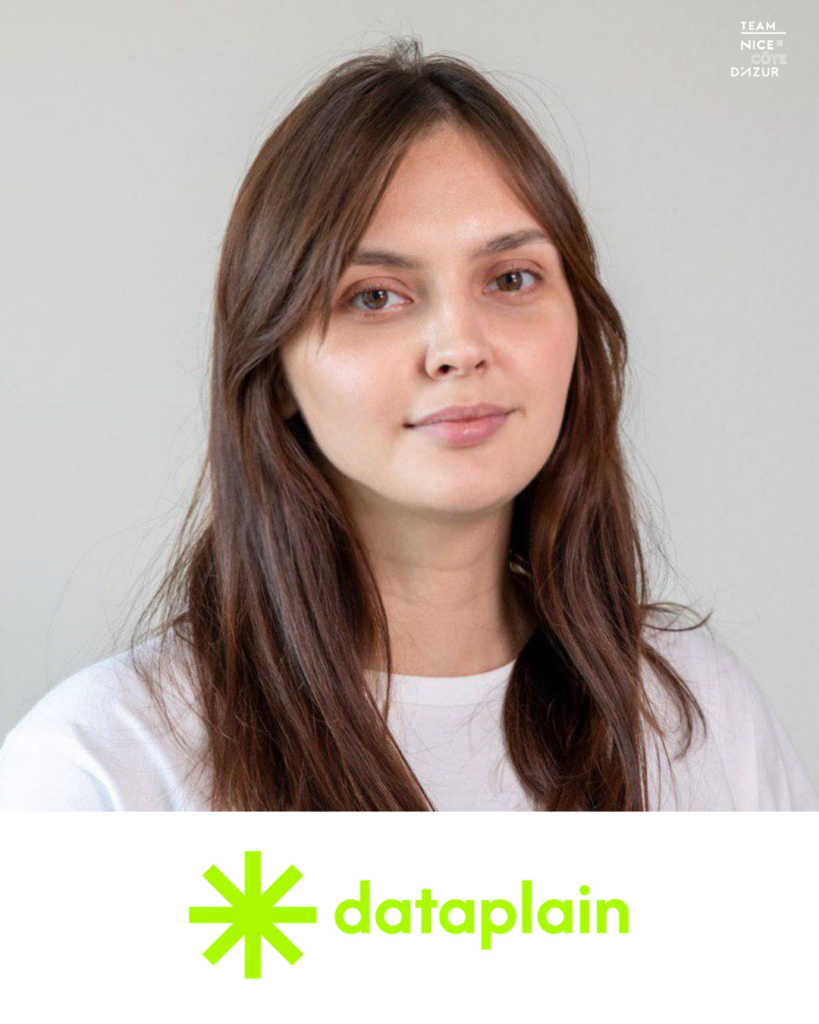
DataPlain is a recently established software company based in Nice Côte d’Azur, specialising in the protection of personal and sensitive data. The company targets small and medium-sized businesses that need to meet GDPR requirements and protect their customers’ information.
Its first product is a free Chrome extension that detects 11 types of personal data in English and French, with a current detection accuracy of around 96–97%. A dedicated browser layer and new modules for Slack, WhatsApp and document protection will be released progressively in 2026. The company plans to create five jobs over three years in Nice. The company plans to create five jobs over three years in Nice.
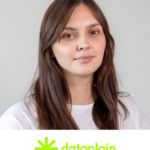
Find below our interview with founder Kathrine Yanchenko.
You are currently building DataPlain on your own. What path led you to create the company?
Kathrine Yanchenko: I studied both computer science and linguistics, with a primary degree in computer science. I then worked in several IT roles – developer, QA, support engineer – before becoming a senior operations manager.
That last position combined the technical and business sides and gave me a clear view of how a company operates and what customers actually need. In parallel, I saw growing demand for privacy and started to research how businesses operate in this environment and how difficult it can be for them to protect their assets.
I completed certifications in cybersecurity and privacy to strengthen both my technical and business understanding.
DataPlain started from there.
How did the original idea for DataPlain evolve into what you are building today?
K.Y.: At the beginning, I wanted to build one all-in-one system. I quickly realised that most companies prefer flexibility. They want to choose and adjust the tools they use according to their risks and priorities.
Today, DataPlain is a set of privacy products that companies can combine. My focus is on small and medium-sized businesses because they are very vulnerable. They generally do not have the budgets, engineering managers or dedicated legal and security advisors that large corporations have. They still have to protect personal and sensitive data, so they need simple, effective tools.
What are your activities today in Nice Côte d’Azur? What is already on the market?
K.Y. : Right now, one product is live: the DataPlain browser which is a Chrome Extension, free to use.
If you have any piece of text and are not sure whether you can copy and paste it to different websites, or if you want to insert it into a tool like ChatGPT, you can first run it through the extension. Before you send anything, you can check that you are not exposing sensitive data.
The extension detects personal and sensitive data in English and French and supports eleven types of sensitive data. You paste your text into the extension, and it automatically finds and hides the parts that should not be exposed.
What will change with the future browser product and the 2026 roadmap?
K.Y.: The current version works well but is based on copy-and-paste. The next step is a real-time detection layer in the browser. Instead of manually pasting text, users will have protection as they type, across the web. When they write an email, chat in a web interface or fill in a form, the system will detect sensitive data in real time and warn them before anything is exposed.
In parallel, I am working on three additional products. The first is protection for Slack, where many SMEs talk to customers and share invoices, contracts and identity details without full visibility. The second extends the same logic to WhatsApp, which is widely used by small businesses and individual contractors. The third is document checking, to analyse files before they are uploaded or reused and highlight personal or sensitive data that should be redacted or treated with more caution.
How do you see your role for SMEs?
K.Y.: Security, compliance, cybersecurity and data privacy all require specific knowledge and technical understanding. Not everyone has that, and I do not think everyone should have to become an expert.
When something looks too complicated, people tend to postpone it. My vision is that DataPlain acts as a proxy. We handle the complex part in the background. Users do not need to know all the technologies or legal details; they just need clear information and simple choices. We provide detection, categorisation and alerts, and the business keeps control over the final decisions.
You chose to base DataPlain in Nice. Why this region in particular?
K.Y.: When I was looking at start-up programs and at countries where I could operate, I wanted a location that would combine several elements: a good ecosystem, innovation, access to talent, and also strategic support and responsiveness from local actors.
Nice Côte d’Azur brought these elements together. With the help of Jean-François Chapperon from Team Nice Côte d’Azur, of the French Tech Côte d’Azur and of other people involved, the region proved to be a great fit. There is access to universities and incubators, and there are people who want to stay here or even move here to work.
It is also a place where many conferences and events happen. You do not feel that you always have to go to Paris or Berlin.
I was positively surprised by the way the region combines a calm lifestyle with a lot of energy. The style of living is very pleasant, but at the same time there are many young people and many universities. There is a strong energy around technology and innovation.
Often, when we think of good weather, we imagine that people are not very focused on work or on studying. Here, I see both: you can enjoy life and a reasonable work–life balance, but you are still in the middle of many activities and conferences.
How did Team Nice Côte d’Azur assist you?
K.Y.: When you are outside France and you do not have any connections to the ecosystem, it is hard even to know whom to contact, how to link yourself to the right people, or how to get your questions answered.
With Jean-François Chapperon, it was very easy. He was very responsive and gave me a clear vision of how the ecosystem looks: who the main players are, whom I should contact, whom I should talk to. For example, we worked with Farouk Raïs from French Tech Côte d’Azur even before I came to France, and afterwards as well.
It was important to have a person I could contact and ask questions. Even if he could not answer directly, he could find other people or bring his own experience. This helped me a lot while I was still outside France, to connect to the ecosystem and to integrate more easily once I arrived. It also helped me decide where to establish the business and who could help with each step.
I also did a small incubation with SKEMA Business School, and I have a strong connection with the French Tech network. Recently, I finished an incubation program with Interfaces, a Paris-based incubator that organised a special Côte d’Azur program in Nice. All these actors contributed to supporting DataPlain at the beginning.
You mentioned development plans and new products for 2026. What are your hiring plans?
K.Y.: One of my top priorities now is to hire. The company is established; the next step is to bring in another person. This could be a co-founder working with me or a hired technician or developer.
There is not enough time to do everything alone. You cannot drive operations, business and technical development at the same speed if you are one person. I want to start small, begin selling and then grow. Growth should be tied to realistic numbers, sales and projections. The plan is to reach around five people within three years.
What kind of profile are you looking for in this first hire or potential co-founder?
K.Y.: I am looking for someone with a strong technical background who wants to develop something innovative and help build a product. A start-up is not necessarily about immediately earning the same salary as in a corporate job; it requires a different mentality.
I need someone who enjoys challenges and solving non-standard problems, and whose skills are complementary to mine, so that we can cover more ground together.
What message would you like to send to local companies, potential clients and partners?
K.Y.: To potential clients, especially SMEs, my main message is that security can be simple. We are happy to help make it simple for you. If you do not know where to start and feel overwhelmed by everything, just reach out. We can provide you with a personal plan on what to do and advice on which of our products, or even other products, could make sense for your situation.
For partners and other tech companies, we would be happy to work together and see what we can do for the French ecosystem.
Contact details:
Website: https://www.dataplain.tech/
Contact Email: Kathrine.Yanchenko@gmail.com or support@dataplain.tech
Liinkedin: https://www.linkedin.com/in/kathrine-ianchenko/
Companies set up in Nice Côte d’Azur
- TradeSource (PGC): the Nice-based deeptech platform set to transform SMEs’ international trade through blockchain

- DataPlain sets up in Nice to protect SMEs’ sensitive data
- SUPMODE & SUP-PHOTO inaugurate their campus in Nice
- SunWaves-MedTech sets up in Nice to develop the connected medicine of tomorrow
- Legal Design Agency chooses Nice Côte d’Azur
- Leather and Yachts: artisanal expertise serving the blue economy
- Business Landing Nice Côte d’Azur: Support for business set up in France
- Welcome to the Nice Côte d’Azur Metropolis
- In Nice, Circum Medtech Pharma is making the Medtech value chain more agile, more reliable, and more efficient
- Nice Côte d’Azur: a dynamic 2024 in the service of attractiveness