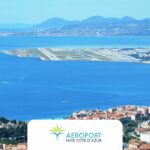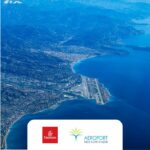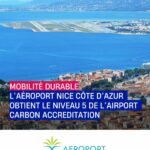


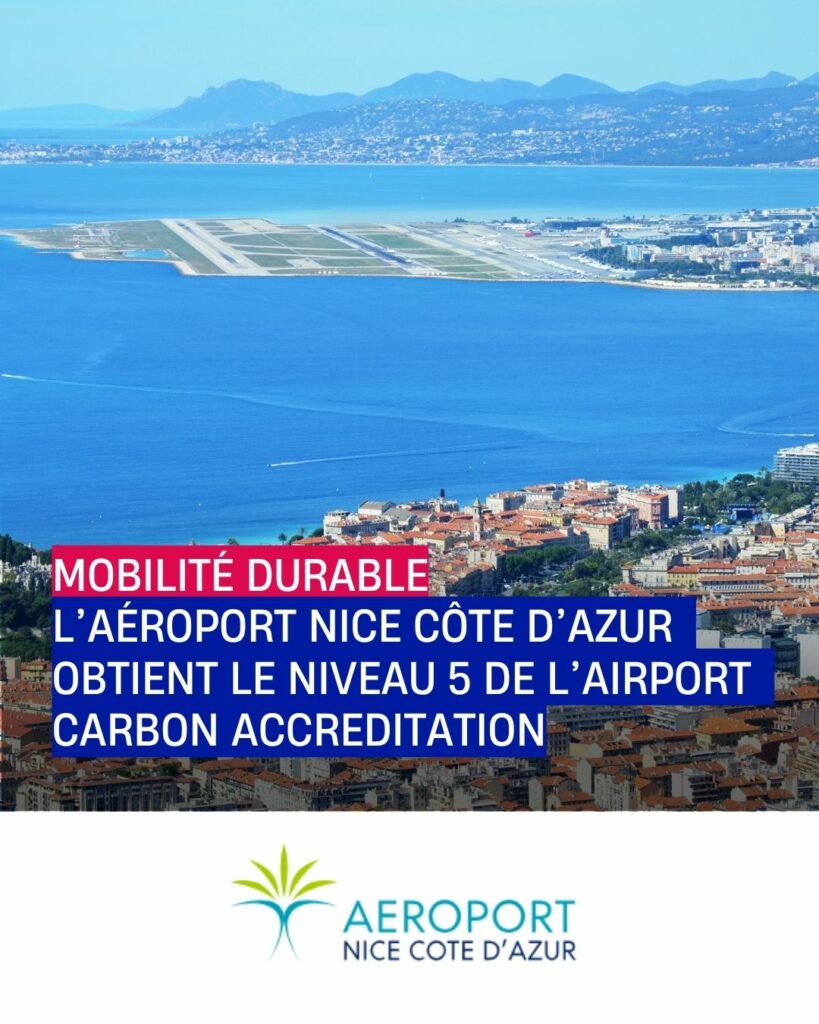
An unprecedented milestone in France. Nice Côte d’Azur Airport becomes the first major French airport to reach Level 5 of the Airport Carbon Accreditation. This certification is the most demanding in the world for airports in terms of greenhouse gas emissions reduction. It has been achieved five years ahead of schedule.
A massive reduction of internal emissions. The airport has reduced its direct GHG emissions by 93% since 2010. It now operates with 100% renewable electricity and decarbonized energy systems. Remaining residual emissions are offset through certified projects.
A decarbonization strategy across the entire value chain. A roadmap aims for carbon neutrality across all indirect emissions by 2050. It relies on sustainable aviation fuels, technological innovation, fleet renewal, and the optimization of air operations.
A positive impact beyond the airport perimeter. The benefits of this transition extend to the entire Côte d’Azur region. They include improved air quality, reduced nuisances, and strengthened access to sustainable mobility. The airport also supports local carbon sequestration projects.
On Monday, September 29, Nice Airport received Level 5 accreditation, the highest and most demanding level of the leading international voluntary program for the management of airport greenhouse gas emissions. It is the first major* French airport to obtain it.
Five years ahead of its planning, Nice Côte d’Azur Airport has joined the restricted group of 4% of airports worldwide engaged in the Airport Carbon Accreditation program that have reached this top level of commitment. This accreditation certifies that the airport has not only reduced by at least 90% the emissions under its control, but has also defined and implemented a decarbonization roadmap for its entire value chain, including aircraft emissions during landing and take-off phases, and their ground operations.
“It is a great source of pride for Nice Côte d’Azur Airport to receive this accreditation. It crowns the relentless work we have carried out for many years to strongly and sustainably reduce the environmental footprint of our activities and those of our partners. It also confirms the promise we made to the people of the Côte d’Azur and to our territory that we could reconcile operational performance with environmental performance, the development of our network with the preservation of the future.”
— Franck Goldnadel, Chairman of the Management Board of Aéroports de la Côte d’Azur
“Congratulations to Nice Côte d’Azur Airport for reaching Level 5, the highest level of Airport Carbon Accreditation. Since joining the program in 2011, the airport has been at the forefront of the fight against climate change, now achieving net zero emissions under its direct control and maintaining a clear target of full decarbonization by 2050. From using 100% renewable electricity to working closely with staff, suppliers, airlines and partners to reduce emissions, Nice Côte d’Azur Airport has established itself as a global leader, raising the bar in innovation, collaboration and decarbonization in the airport sector.” Olivier Jankovec, Director General of ACI EUROPE
This distinction rewards the commitment of Nice Côte d’Azur Airport as a pioneer in decarbonization and a laboratory of tomorrow’s airport. It attests to:
- A verified carbon footprint in line with the highest international standards (GHG Protocol and ISO 14 064).
- A revised carbon management plan demonstrating a sustainable reduction of more than 90% in its own emissions (scope 1 & 2) since its reference year (2010).
- An updated stakeholder partnership plan providing information on the progress of partners in reducing emissions against their targets.
- A “Net Zero Emissions” decarbonization roadmap for its value chain (scope 3), to achieve a 90% reduction by 2050. This roadmap will be reviewed every six years, with the airport required to demonstrate progress towards the long-term goal and milestones.
The achievement of “Net Zero” on its own emissions (scope 1 & 2).
Since 2010, Nice Côte d’Azur Airport (NCAA) has implemented an ambitious plan to reduce its carbon footprint, enabling it to reach a 93% reduction in GHG emissions linked to its activities in 2024. This results from key actions such as:
- The transition to 100% renewable electricity for all its facilities.
- The deployment of an electric vehicle fleet.
- The use of HVO 100 biodiesel for generators.
- The optimization of energy consumption in infrastructures and equipment.
- The substitution of gas boilers with geothermal systems and waste heat recovery (tempered water loop).
Residual incompressible emissions (scopes 1 & 2) are now fully absorbed through certified projects. The long-term objective is to absorb all these residual emissions through its own local carbon sequestration projects (reforestation projects with the French Forestry Office, initiated continuously since 2020).
With this experience, the airport is now aiming for “Net Zero Emissions” across its entire carbon footprint by 2050. To this end, it has developed a decarbonization roadmap validated by Airport Carbon Accreditation in the framework of its Level 5 application.
A validated roadmap to decarbonize the value chain
To achieve neutrality by 2050 — that is, a 90% reduction and maintenance of GHG emissions compared to the 2024 reference year — the airport has implemented a roadmap shared with its partners, including airlines and ground handlers. It relies on four levers:
- Deployment of Sustainable Aviation Fuels (SAF): Replacing kerosene with biofuels that reduce carbon impact by 90% over their full lifecycle, in compliance with European regulations.
- Anticipation of technological breakthroughs: Deploying infrastructures adapted to the energy transition of aircraft (hydrogen and electric).
- Fleet renewal: Benefiting from technological advances in aircraft design, with the entry into service of more efficient, less energy-consuming aircraft.
- Optimization of operations: Collaborating with authorities on flight trajectory optimization, continuous descent, and improved taxiing times.
These pillars of aviation decarbonization are complemented by non-aviation actions such as expanding public transport and electric charging stations to decarbonize airport access, as well as implementing responsible purchasing policies that integrate decarbonization.
A shared benefit for the territory
This certification benefits not only the airport but also the entire territory and its stakeholders. It enables the people of the Côte d’Azur to envision sustainable and decarbonized mobility.
Additional co-benefits also result from this approach for residents, passengers, and employees, including improved air quality, reduced noise pollution, and the development of sustainable mobility solutions.
Definitions
Scope 1: Direct GHG emissions from sources owned and/or controlled by the airport, e.g., combustion emissions from boilers, furnaces, vehicles, etc. owned and/or controlled by the airport.
Scope 2: Indirect GHG emissions from the generation of purchased electricity, steam, heating or cooling consumed by the airport. Scope 2 emissions are physically produced at the facility where the purchased electricity is generated.
Scope 3: All other indirect emissions that are a consequence of the airport’s activities but occur from sources not owned and/or controlled by the company (e.g., aircraft movements on the ground and in the air, third-party vehicles and equipment, off-site waste treatment, etc.). These sources may be located on-site or outside the airport’s geographical perimeter.
* Airports handling more than 14 million passengers per year.
Source: Aéroport Nice Côte d’Azur
Nice Côte d’Azur Connectivity
- United Airlines reactivates the Nice–Washington route in summer 2026

- Nice Côte d’Azur: Second Place in Quality of Life Among Major French Metropolises in the 2025 Arthur Loyd Barometer
- Nice, 5th largest city in France by population
- Nice Côte d’Azur Airport closes 2025 with record traffic, major infrastructure delivery and highest-level environmental recognition
- easyJet launches a direct Nice–Madeira route from 6 June 2026
- easyJet to Launch Nice-Birmingham Route Starting May 2026
- Emirates retrofitted A380: new Premium Economy Class in Nice
- Nice Côte d’Azur Airport reaches Level 5 of the Airport Carbon Accreditation