

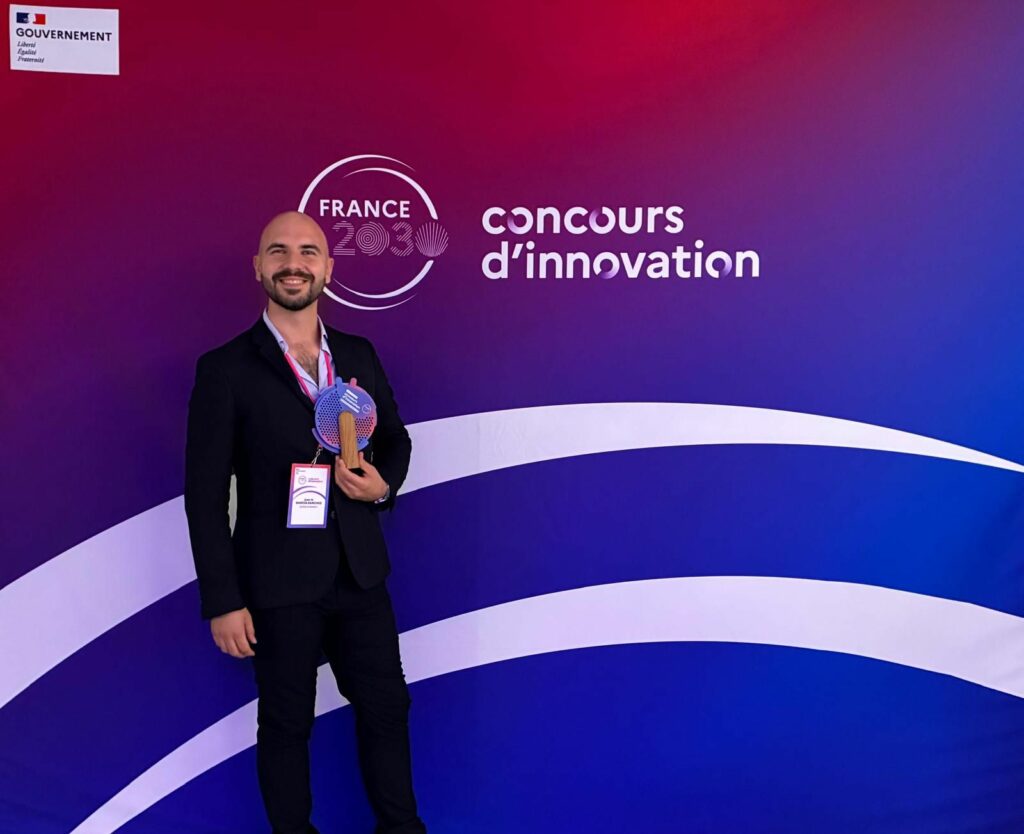
A spin-off from Université Côte d’Azur, Inserm and CNRS, DimiCare Biotech is among the winners of the i-Lab 2025 competition, organised as part of the France 2030 plan.
The company focuses on developing a new generation of antibiotics designed to combat infections that are resistant to multiple treatments, without creating new resistances.
DimiCare Biotech, whose incorporation as a company is planned for early 2026, is already relying on a multidisciplinary team of researchers in biology and chemistry, experts in pharmaceutical development, and specialists in clinical microbiology and infectious diseases.
From 2026 onwards, DimiCare Biotech will enter a strategic phase, with the launch of preclinical studies on its first therapeutic candidate, the preparation of a €3 million fundraising round, and the continued structuring of the company, anchored in the Nice Côte d’Azur area.
Interview with Juan Antonio Garcia-Sanchez, PhD, CEO/CSO of DimiCare Biotech.
You are among the winners of the i-Lab 2025 competition. What does this distinction mean for your project?
The i-Lab competition is a major recognition. It is both a scientific and an entrepreneurial validation of our programme. We were assessed on the robustness of our technology, our business model, our development strategy… and even on our ability to lead a team.
This shows how structuring the i-Lab label is. It gives us national visibility and acts as a lever for other funding, particularly private financing.
What is DimiCare Biotech working on in practical terms?
We are developing a new generation of so-called “precision” antibiotics. This means that they very precisely target specific pathogenic bacteria, without affecting the micro-organisms that are beneficial to our health or to the environment.
Our first programme, DCB-001, targets Staphylococcus aureus, a bacterium responsible for many infections, especially in its forms that are resistant to conventional antibiotics. We have discovered a compound capable of eliminating 100% of the targeted strains, without triggering the emergence of new resistances.
Is the project already structured as a company?
DimiCare is currently a spin-off in the process of being created, with legal incorporation planned for 2026. We are now in a pre-creation phase, but we already have the team, the technology and a pipeline under development.
The DCB-001 programme is the most advanced, but other projects – notably against other bacteria, parasites or fungi – are being evaluated, even if some of them remain confidential at this stage.
How did the project emerge?
It all started at the end of my PhD. At that time, I wanted to move from academia to industry and was particularly attracted to entrepreneurship. In discussions with the head of my host laboratory at C3M (INSERM), Dr Laurent Boyer, he suggested that I continue a project he had initiated in collaboration with Professor Cyril Ronco’s team at the Institut de Chimie de Nice (CNRS), aimed at discovering new antimicrobial treatments. I obtained an ATER position at Université Côte d’Azur and an initial LabEx/IdEx grant from the University, which enabled us to obtain the first proof-of-concept results and confirm the relevance of the project.
I then took over the project with the clear objective of turning it into a company. Since 2023, we have drawn up a development plan that has allowed us to obtain several in vitro and in vivo proofs of concept, paving the way for decisive steps such as securing R&D-oriented funding, including the “Jeunes Docteurs Innovants” call for projects from Région Sud, and the CATRIEM and CNRS pre-maturation programmes. We also benefited from entrepreneurship-focused schemes, including the i-PhD innovation competition, Bpifrance’s BFT-Lab support, and the support programme of the Provence Côte d’Azur incubator and Pépite. Finally, winning the i-Lab competition in 2025 allows us to continue this journey and envisage the creation of DimiCare in 2026 with confidence.
A team of around ten people is now involved in the project, including microbiologists, clinicians and strategic experts.
How does the local ecosystem support the development of DimiCare Biotech?
The local ecosystem has been a real driving force in structuring the project. Nice offers an environment where laboratories, companies and technology transfer structures collaborate smoothly. It is a human-scale city, but with strong and growing scientific and technological potential.
We benefited very early on from the YEP – Young Entrepreneur Program, led by the LabEx/IdEx of Université Côte d’Azur, which enabled us to fund a first engineering position. I was also supported under the national student-entrepreneur status (SNEE) with Pépite Méditerranée for two years, as well as through a pre-incubation phase at the Provence Côte d’Azur incubator, which played a decisive role in my transition from research to entrepreneurship.
From a technological perspective, our project has benefited from three distinct pre-maturation schemes:
- one from CNRS, via the chemistry laboratory,
- one from Inserm/Pulsalys, for the biology work,
- and one from SATT Sud-Est, which also supported us in structuring our intellectual property.
Finally, this year we are part of the international programmes Nucleate and Ulysseus European University, of which Université Côte d’Azur is a founding member. This not only illustrates the tremendous support DimiCare has received since the beginning of the journey, but also reflects a fast-growing deeptech entrepreneurial ecosystem in our region.
What are the next steps for DimiCare Biotech?
We are preparing a €3 million fundraising round to finance the preclinical phase of DCB-001. The i-Lab award will help us structure this process and accelerate our development, while preserving our independence.
In parallel, we are open to co-development partnerships with other companies or laboratories interested in antimicrobial innovation, in order to continue developing the medicines of tomorrow.
A final word for the economic or scientific stakeholders reading you?
DimiCare is an ambitious entrepreneurial venture, combining robust and exciting science, a clearly identified medical need and a strong industrial growth opportunity. If you are an early-stage investor, or if you work in the field of anti-infectives and would like to co-develop new solutions, we are open to discussion. We see cooperation as a driver of impact.